
Evolution in two different senses
Biological evolution explains changes in living populations across generations. “Man’s Evolution” asks a different question: can consciousness and character develop through a much longer journey? The title comes from older Theosophical writing and uses “man” for humanity. That spiritual meaning of evolution should not be confused with evolutionary biology or used to rank the worth of people.
A Theosophical view of evolution
Theosophical teaching describes several “kingdoms of nature”: three elemental kingdoms, then mineral, plant, animal and human life. These names mark stages in a spiritual journey of consciousness. The elemental kingdoms refer to levels of life described in Theosophical literature.
Biological evolution studies how living populations change across generations. Theosophical evolution asks how consciousness might develop through many kinds of life. The two address different questions, even when they use some of the same words.
Theosophical writers use “individualisation” for a change from a more collective mode of life toward a distinct, continuing individuality. The idea links growing self-awareness with freedom and responsibility.
Older Theosophical writing sometimes ranks people and cultures. Such rankings should not guide us. Every person has equal dignity. No language, ethnicity or community shows a lesser stage of consciousness. We should question any use of spiritual growth that diminishes other people.
C. Jinarajadasa also describes seven “chains” of globes within one scheme of evolution. In his account, a chain is a long cycle of experience across different levels of existence. The Earth chain is the fourth.
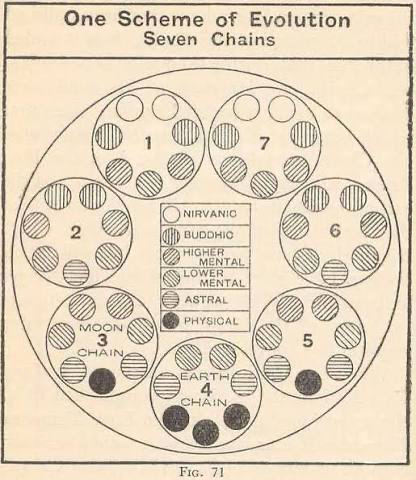
Seven chains within a wider cosmic scheme
Arthur E. Powell describes several schemes of evolution within Theosophical teaching about the solar system. He uses the term “Solar Logos” for the spiritual life said to guide that larger whole. Each scheme is said to include long cycles of development. Powell’s description reaches far beyond the story of human life on Earth.
Names such as Earth and Venus appear in this writing. Powell uses them while describing long cycles of time and the development of consciousness.
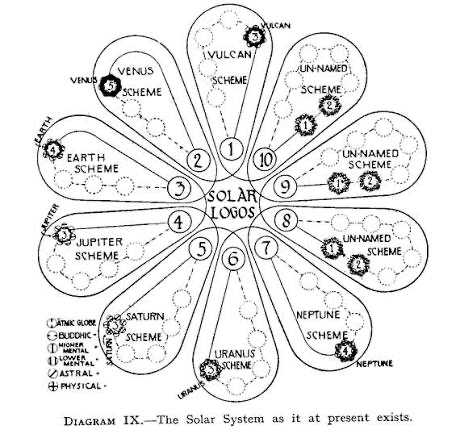
Karma and repeated lives
Reincarnation proposes that one life is not the whole story: an enduring self returns to new conditions and keeps learning. Karma describes a relationship between intentional thought, speech and action and their consequences. In Theosophical teaching, repeated lives offer opportunities to meet the results of earlier choices and to respond differently.
Karma is sometimes reduced to a system of instant reward and punishment. Theosophical interpretations are more complex: effects may be delayed, conditions are intertwined, and a person’s freedom lies partly in how they respond now. Even on those terms, an observer cannot read a stranger’s hidden history from poverty, illness or grief. Treating hardship as deserved would turn spiritual speculation into cruelty.
Consider a mistake you have made. Its consequences may persist even after you recognise it, yet an apology, changed behaviour and patient repair can matter. That ordinary example does not demonstrate rebirth, but it shows why cause, effect and responsibility are central to the teaching. Actions shape habits and relationships; learning means more than feeling regret.
The idea of repeated lives also raises difficult questions. What continues if memories do not? How should we understand identity when bodies and circumstances change? Theosophical writers propose an enduring individuality that gathers the lessons of experience, rather than a personality copied unchanged from one lifetime to the next. Readers are free to test whether that distinction is coherent.
Jinarajadasa calls the changing habits and roles of one life the “personality”. He uses “individuality” for the deeper self said to continue through many lives. This difference is central to the Theosophical view of rebirth. It also leaves a hard question: if we do not remember a past life, in what sense are we the same person?
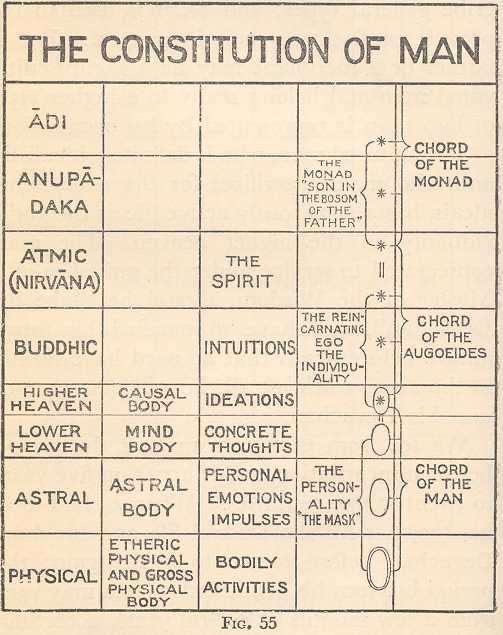
What spiritual development could mean today
Theosophical writings often describe a movement from ignorance toward understanding and from self-concern toward patience, generosity and service. This is not a ladder on which we can place our neighbours. A person may be thoughtful in one setting and careless in another. Growth is uneven, relational and often visible through small acts rather than grand claims.
The practical question is not “How advanced am I?” but “What am I learning from the way I live?” A difficult conversation may offer a chance to listen. An error may invite repair. A privilege may become an opportunity to help someone with less access or support. None of these choices requires us to know where anyone stands in a cosmic scheme.
A long view can also encourage patience. People rarely change all at once; habits are built and rebuilt. Yet patience should not become an excuse for avoiding urgent harm. A commitment to spiritual learning is compatible with setting boundaries, seeking justice and responding to material needs. Service is more than an inward attitude when another person needs practical help.
Readers who are uncertain about reincarnation can still examine whether this way of thinking makes them more responsible today. Those who accept the doctrine can ask the same question. The strongest ethical outcome would be less superiority and more care. The next article looks at Theosophical ideas about life after death, while leaving space for grief and uncertainty.
The language of “evolution” can suggest that history moves smoothly toward improvement, but individual lives rarely feel smooth. People learn amid setbacks, obligations and unequal opportunities. If growth is a meaningful idea, it must make room for those realities. It should call us to improve conditions for others, not simply admire our own intentions.
Theosophical teachings also place value on service. Insight has a social dimension when it changes how we share time, knowledge or resources. A person may study deeply and still need to ask who is absent from the conversation. The worth of inquiry is tested partly in whether it helps widen compassion.
A little more to consider
A long view can make growth feel possible, but it can also be misused to dismiss suffering or divide people into supposed levels. Hold onto the ethical test: does an idea make you more honest, responsible and compassionate toward real people?
One small next step
Recall one choice you would make differently if given another chance. What repair or kinder action is possible today? The next article considers death within this proposed cycle of lives.